there is no such thing as “fact” or “truth”

We live in a world ruled by majority opinion. What the mass populous agrees on is accepted as truth.

“There are no facts, only interpretations.”- Friedrich Nietzsche

This is both dangerous and debilitating, creating a world in which there are “correct” answers to questions and in which those who shout the loudest own the truth. This is something that begins at school and remains with you in life.

It was a fact that there were 9 planets in the solar system. Then it was a fact there were ten. Now it’s a fact that there are 8.

Facts are fluid and the truth is grey. The sooner you loose the shackles of believing in fact, the sooner you will release yourself and your thinking. Once you know that there are no right answers you can do anything and think anything.

This is the essence of divergent thinking and creativity. What has gone on before is not right, but a version of right, to which there are many other answers.

At medical schools, students are told: “50% of what we teach you over the next five years will be wrong, or inaccurate. Sadly, we don’t know which 50%”. That’s medical school! You know, the science of medicine. Much of what they learn is not just inaccurate, but later proved to be wrong..!

And when people question this, they are unaware of the beautiful irony of disputing my “fact” that there are no facts. And I would agree. I cannot prove this. I can only deliver the evidence…
permission to break the rules

My wife and I decided to call our son Bo. It was a name chosen for a very simple reason. We like the name Bo. Hugely popular in Sweden and Denmark, there a very few people called Bo in the UK. Perhaps we broke the rules..?

Out for a walk in the park, I would be stopped by people wanting a closer look at this blue-eyed cutie and the conversation would go like this:

“He’s lovely, what’s his name?”

“Bo”

“Right. That’s unusual.”

“It’s a Scandinavian name, very popular in Denmark and Sweden.”

“I see… Are you Swedish?”

“No”

“Is your wife?”

“No”

“Is there a connection to Scandinavia?”

“No, we just like the name.”

“Oh OK…. that’s an unusual name… why call him Bo…?”

“We like the name.”

“Oh I see… OK…”

Later on I realised that there was a far easier way to handle this conversation. My intention was not to mislead, but in fact the exact opposite. I needed others to feel comfortable with the rules I had broken. My mother called this a “white lie”. It’s intention was to conceal the truth in order to make life that little bit easier. “Your grandmother doesn’t need to know we went to London. It will upset her that she wasn’t invited”. That sort of thing.

In short, I needed to show them that I had not broken the rules and that everything was OK. At this point, the conversation when like this:

“He’s lovely, what’s his name?”

“Bo”

“Right. That’s unusual.”

“It’s Scandinavian, my wife’s family are from Sweden.”

“Oh I see. What a lovely name. He’s beautiful.”

“Bo… Yes, it suits him…”

Now let us return to breakfast. In Germany, Belgium or across Europe, do you ever sneak a piece of cheese or ham onto your plate of toast or pastries? Do you order fried sausages and black pudding in London? Or indeed laver bread and cockles when visiting the beautiful Welsh coast?

Do you ever ask yourself why this is acceptable to you now, in this context and not at home? The reason is you have been given permission to break the rules. More to the point, you have given yourself permission to break the rules and the justification for rule breaking to the others around you. No one will look at you like a freak show, because you are among company. For a start, other people are eating this stuff right?

the rules of breakfast

Ask a room full of people what they had for breakfast and you’ll probably get a similar response. Cereal, toast, eggs, bacon, perhaps the odd muffin or pastry. Carb-based, brown food, tea and coffee and the odd glass of juice. That’s about your lot.

Now, ask the same question to people in different countries. Again, the variance in response is tight. The difference, however, is that now you have a whole new set of answers. There are acceptable foods for breakfast, built on the rules of conformity.

There are of course the mavericks. The freaks, odd-balls and witches, who chow down on last night’s pizza, curry or perhaps a chocolate bar. The ones who are met with one of the most excepted and strangest comments you will ever hear: “you can’t eat that for breakfast.”

A comment to which there is only one response: “who the f*ck says so…?”

Who the hell told us there were rules for breakfast? Our parents, the various agencies of socialisation, cereal advertisers and the media? Whoever it was, it doesn’t excuse the fact that pretty much all of us follow these unwritten rules on a daily basis. We spend our working lives following norms and procedures that have never been formalised or written down. More to the point, they never existed in the first place. We created them ourselves. And we enforce them on ourselves.

Think about that for a second.

What can we do, as human beings, workers, managers and thinkers, to disrupt this vicious constraint in our lives? Imagine what’s possible when you stop following rules. Rules that were never there in the first place.

Featured image

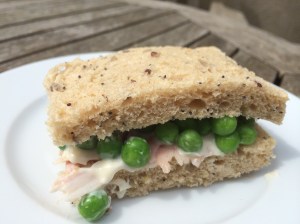
My son asked for a pea and ham sandwich… and this is what he got…